Berkeley Heights · Union County
Roof Repair Services in Berkeley Heights, NJ
Storm Guard Roofing delivers targeted roof repair services in Berkeley Heights, New Jersey. Operating for over 25 years as a family-owned, licensed, and insured contractor, we provide technical repair solutions for residential roof leaks, structural storm damage, and flashing failures. Berkeley Heights homes—particularly those situated along heavy tree canopies near the Watchung Reservation, Free Acres, and the Glenside Avenue corridor—face distinct structural stresses. Dense foliage, heavy ice accumulation on low-slope eaves, long roof planes, and aging skylight seals cause leaks that demand precise, localized repair rather than total roof replacement. We offer 24/7 emergency response for wind and branch impacts and handle insurance claims from start to finish. For immediate dispatch or a diagnostic inspection, call (201) 403-0024.
Diagnosing Roof Leaks on Long Roof Planes and Skylights
Berkeley Heights residential architecture often features long, continuous roof planes on ranch, split-level, and colonial designs. These wide expanses of asphalt shingles collect high volumes of runoff during severe Union County rainstorms. When water travels over long runs of shingles, minor shingle misalignments or hidden punctures allow water to enter the underlying roof assembly. Water frequently travels horizontally along underlying rafters or plywood sheathing before showing through bedroom or hallway ceilings, making accurate leak tracing essential.
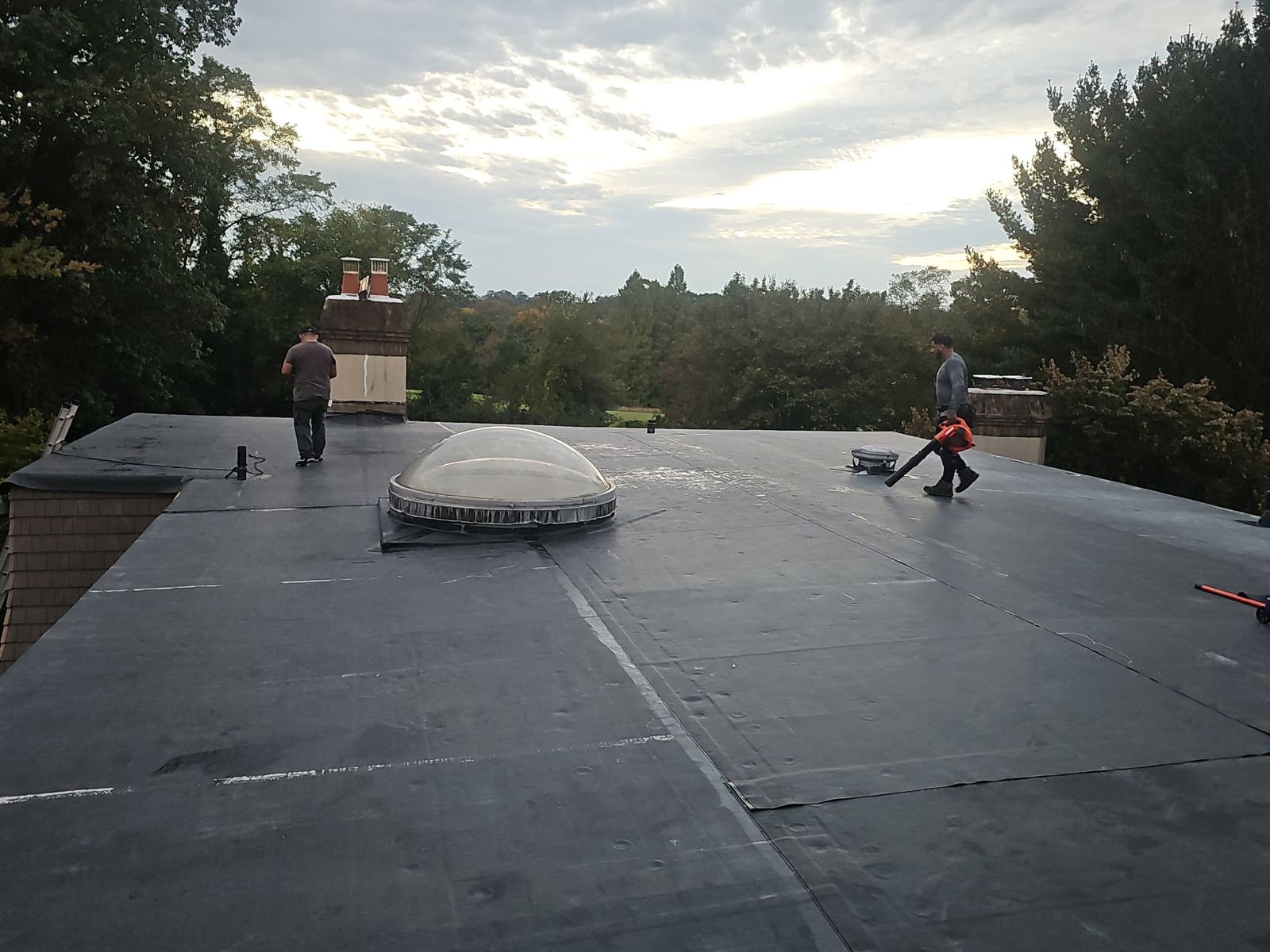
Wooded lots across Berkeley Heights drop high amounts of oak leaves, pine needles, and organic debris onto roof surfaces. This organic material holds moisture against shingle surfaces, accelerating granule loss and causing localized asphalt degradation. Furthermore, skylights installed on long rear slopes present critical vulnerability points. As skylight gaskets dry out and step flashing corrodes beneath decaying leaf litter, water penetrates around the curb frame, rotting the surrounding roof deck.
- Direct identification of horizontal water travel along interior rafters to locate exact shingle entry points
- Skylight curb flashing teardown, sealant replacement, and membrane re-wrapping
- Shingle granule erosion assessment on long-plane slopes exposed to heavy overhead shade
- Repair of compromised decking surrounding sun tunnels and traditional skylight openings
Flashing, Valley, and Pipe Boot Failure Mechanisms
Roof penetrations and transitions account for the vast majority of non-storm roof leaks in Union County. In older Berkeley Heights homes, step flashing along sidewalls, dormers, and brick chimneys degrades over time. Mortar joints surrounding counter-flashing loosen due to seasonal freeze-thaw contraction, allowing water to trickle behind the metal apron into interior wall cavities.
Valleys carry the highest volume of water on any roof. In Berkeley Heights, closed-cut valleys frequently fail when pine needles and twigs wedge beneath shingle overlaps. This debris forces rainwater laterally, pushing it past the shingle edge where it infiltrates unsealed decking joints. Additionally, neoprene boots around plumbing vent stacks harden and crack after 10 to 15 years of ultraviolet exposure, permitting direct rain penetration into the attic space.
- Step flashing reset and counter-flashing repointing into masonry chimney mortar joints
- Conversion of clogged closed-cut valleys to open metal valleys using aluminum or copper
- Replacement of split, UV-degraded neoprene pipe boot collars with metal base boots
- Wall apron flashing repairs along second-story additions and dormer intersections
Ice Damming Repairs at Low Eaves and Ridge Ventilation
The microclimate in Berkeley Heights, created by the surrounding Watchung Hills, brings sustained winter freezing and snow loads. Many local homes feature low-eave overhangs over unheated soffits, deep porches, or attached garages. Heat escaping from living areas warms the upper roof deck, melting snow that runs down to the colder low eave. There, the water refreezes, forming an ice dam that traps subsequent runoff.
Trapped water backs up beneath asphalt shingle courses, bypassing standard underlayment and leaking through roof sheathing joints onto ceiling insulation. Our repair approach addresses both the physical damage and the underlying causes. We strip damaged lower shingle courses, replace rotted plywood, and install self-adhering ice and water shield membranes that extend up the slope past the interior wall line. We also evaluate eave and ridge ventilation to balance attic temperatures.
- Selective tear-off of ice-damaged eave sections down to the structural plywood decking
- Installation of self-adhered rubberized asphalt ice and water membranes
- Replacement of water-damaged fascia boards and compromised soffit vents
- Assessment and correction of ridge vent airflow bottlenecks to equalize attic temperature
24/7 Emergency Tarping and Storm Damage Response
Severe weather frequently brings down mature tree branches across Berkeley Heights properties, particularly near Diamond Hill Road and Mountain Avenue. High wind gusts can strip shingle tabs, exposing raw wood decking to wind-driven rain. When structural breaches occur, immediate action is required to prevent secondary interior water damage, mold growth, and ceiling failures.
Storm Guard Roofing operates a 24/7 emergency response team reached at (201) 403-0024. We secure compromised roof areas using heavy-duty tarping systems anchored with wood lath boards fastened into structural framing to prevent wind uplift. Following emergency stabilization, we handle the insurance claims process by delivering itemized damage assessments, photo documentation, and scope estimates directly to your insurance adjuster.
- Immediate 24/7 emergency tarping and temporary weather-proofing following branch impact
- Secure structural anchoring designed to withstand high-wind secondary storm fronts
- Comprehensive storm damage documentation including photos and moisture mapping for claims
- Direct communication and scope reconciliation with insurance adjusters
Repair Economics vs. Full Replacement and Local Code Compliance
Homeowners often evaluate whether a localized repair is viable or if a full replacement is required. If the underlying asphalt shingle field retains its structural flexibility, granule layer, and adhesion, repairing isolated flashing leaks or storm damage is a practical choice. A targeted repair restores structural integrity without incurring the capital expense of a total roof replacement.
When performing roof repairs in Berkeley Heights, adherence to municipal building protocols is required. Minor repairs involving localized shingle replacement or flashing touch-ups typically do not require building permits, allowing rapid execution. However, if structural decking replacement exceeds local thresholds, work must comply with the Berkeley Heights Building Department codes. Storm Guard Roofing ensures all repairs meet current New Jersey Uniform Construction Code standards.
- Diagnostic assessment of remaining shingle life span to evaluate repair viability
- Targeted spot repairs for localized valley, pipe boot, and flashing failures
- Full compliance with New Jersey Uniform Construction Code and local township regulations
- Detailed repair scopes outlining materials, structural labor, and underlying deck repairs
Berkeley Heights questions we get asked
- Why do roofs in Berkeley Heights experience ice damming on low eaves?
- Dense tree shade combined with low-slope eave overhangs near unheated soffits creates temperature differentials. Escaping attic heat melts snow higher up the roof plane, which then refreezes over cold low eaves, forcing backed-up water underneath shingle edges.
- Can Storm Guard Roofing handle my insurance claim after storm damage?
- Yes. We document all storm damage, provide detailed line-item repair estimates, install temporary emergency tarping, and work directly with your insurance adjuster throughout the claim verification process.
- How do high tree canopies in Berkeley Heights impact roof flashing and valleys?
- Oak leaves, twigs, and pine needles accumulate in roof valleys and behind chimney flashing. This trapped organic matter retains moisture, accelerates metal corrosion, breaks down mortar joints, and forces runoff water sideways underneath shingles.
- When is a roof repair appropriate instead of a complete roof replacement?
- A targeted repair is appropriate when leaks are isolated to specific penetrations, valleys, or storm-damaged sections, provided the surrounding shingles remain flexible, adhere properly, and retain sufficient asphalt granule coverage.
More in Berkeley Heights
Call (201) 403-0024 for a Berkeley Heights inspection, or send the form.