Clark · Union County
Targeted Roof Repair Services in Clark, Union County, NJ
Storm Guard Roofing provides technical roof repair and emergency mitigation services across Clark and surrounding Union County neighborhoods. Operating as a family-owned business for over 25 years, our licensed and insured team focuses on targeted repairs, leak diagnostics, and insurance claim support rather than selling unnecessary full replacements. Call (201) 403-0024 for 24/7 emergency response. The housing stock in Clark consists largely of post-war Cape Cods, expanded ranches, and split-level homes built during the mid-20th century. These properties often feature short eave overhangs and original or aging sectional gutters that have reached the end of their service life. Combined with severe North Jersey weather—including heavy snow loads, ice damming, and summer rainstorms—these structural characteristics create specific failure points around dormers, eaves, and flashing joints. We pinpoint water entry paths and perform mechanical repairs that restore roof integrity.
Addressing Common Leak Points in Clark Housing Stock
Residential properties built throughout Clark during the post-war expansion often present distinct architectural vulnerabilities. Cape Cod homes and low-pitch ranches around areas like Raritan Road, Madison Hill Road, and Oak Ridge Road frequently feature shallow eave margins measuring 6 to 12 inches. When original or aged sectional gutters fail, overflow travels directly into soffits, fascia boards, and under the starter shingle course.
Sectional gutters near the end of their operational life frequently develop loose spike-and-ferrule fasteners, joint separation, and pitch sagging. During severe downpours, backed-up water migrates upward beneath the lower courses of asphalt shingles via capillary action. Additionally, Cape Cod dormer walls create long vertical-to-horizontal intersections. Over time, seasonal thermal movement weakens step flashing and sealant joints along these dormers, leading to active leaks that manifest inside second-floor ceilings and interior wall cavities.
- Gutter overflow backing up under starter shingle courses due to shallow eave margins
- Step flashing deterioration along Cape Cod dormer sidewalls and front transitions
- Neoprene pipe boot failure around plumbing stacks, leading to bathroom ceiling stains
- Shingle lift and granule loss caused by localized wind gusts along flat, exposed lots
Flashing Restoration and Valley Component Repairs
Roof leaks rarely originate in the field of an undamaged shingle; they stem from component failures at wall transitions, valleys, and penetrations. Flashing systems rely on overlapping metal layers to channel water onto shingle surfaces. When metal step flashing rusts, shifts, or separates from brick masonry or vinyl siding, water bypasses the primary roofing layer entirely.
Our repair process avoids temporary surface patches or heavy coats of roof cement that degrade under ultraviolet exposure. We lift adjacent shingle courses, inspect the underlying decking for rot, and install continuous ice and water self-adhering membranes behind new metal flashing. In valley areas where high volumes of water converge, we replace worn woven or open metal valleys with high-grade underlayments and properly lapped shingle courses to handle peak runoff without backing up.
- Removal of surrounding shingles to expose compromised underlayment and structural decking
- Installation of self-adhering ice and water shield membranes along valley lines and wall intersections
- Precision cutting and tuck-pointing of copper or aluminum counter-flashing into chimney mortar joints
- Replacement of cracked neoprene pipe boots with heavy-duty lead or silicone flashing boots
24/7 Emergency Tarping and Storm Damage Mitigation
High-wind events, coastal low-pressure systems, and severe summer thunderstorms across Union County can cause sudden shingle uplift or limb impact. When structural openings occur, immediate stabilization is essential to prevent secondary water damage to insulation, electrical systems, and finished living spaces. Storm Guard Roofing maintains a 24/7 emergency dispatch team at (201) 403-0024 to secure properties immediately after storm damage occurs.
Emergency tarping requires precise mechanical attachment to protect the roof structure without causing further damage to viable shingles. We secure heavy-duty synthetic tarpaulins using wooden furring strips anchored directly into structural rafters or solid roof sheathings. This temporary barrier stabilizes the building envelope while insurance inspections and permanent repair scopes are finalized.
- 24/7 emergency dispatch for wind damage, tree impacts, and structural water breaches
- Secure tarpaulin installation engineered to withstand wind loads without stripping adjacent shingles
- On-site containment of structural water leaks to protect interior sheetrock and finishes
- Initial photo-documentation of physical damage prior to temporary containment for claim records
Insurance Claim Assistance and Adjuster Coordination
Filing an insurance claim for roof repair requires technical documentation that accurately separates sudden storm damage from long-term wear and tear. Storm Guard Roofing assists Clark homeowners through the entire claims procedure. We provide detailed itemized estimates that document damaged shingle fields, lifted flashing, dented ridge vents, and broken roof decks.
Our team meets on-site with insurance adjusters during their field inspections to review the damage scope directly. Providing objective data—such as wind-blown shingle counts, crease patterns from high winds, and impact marks—helps ensure your adjuster understands the exact scope of work required to restore your roof system to local code standards.
- Comprehensive field inspections providing photographic evidence of storm-related damage
- Itemized repair scopes written using standard industry estimation software
- Direct representation during insurance adjuster physical field walkthroughs
- Verification that repair scopes comply with current Clark Township building code requirements
Evaluating Spot Repair Costs Against Full System Replacement
Determining whether to perform a targeted spot repair or replace an entire roof comes down to structural integrity, shingle age, and localized damage area. When a roof exhibits isolated damage—such as a single flashing breach, localized tree limb damage, or worn pipe boots on a shingle field under 15 years old—spot repair provides a cost-effective solution that preserves the remaining service life of the roof.
If the shingle field exhibits widespread granule loss, thermal splitting, curling, or compromised decking across multiple slopes, spot repairs yield diminishing returns. We assess the physical condition of the asphalt mat, shingle adhesion, and deck firmness to provide factual recommendations. When repairs involve structural modifications or multi-square replacements, we assist homeowners in securing necessary building permits through the Clark Township Construction Code Enforcement office.
- Detailed technical assessment of shingle flexibility, adhesion, and remaining granular cover
- Financial comparison between targeted component restoration and full roof replacement
- Permit determination and submission guidance through Clark Township Construction Code Enforcement
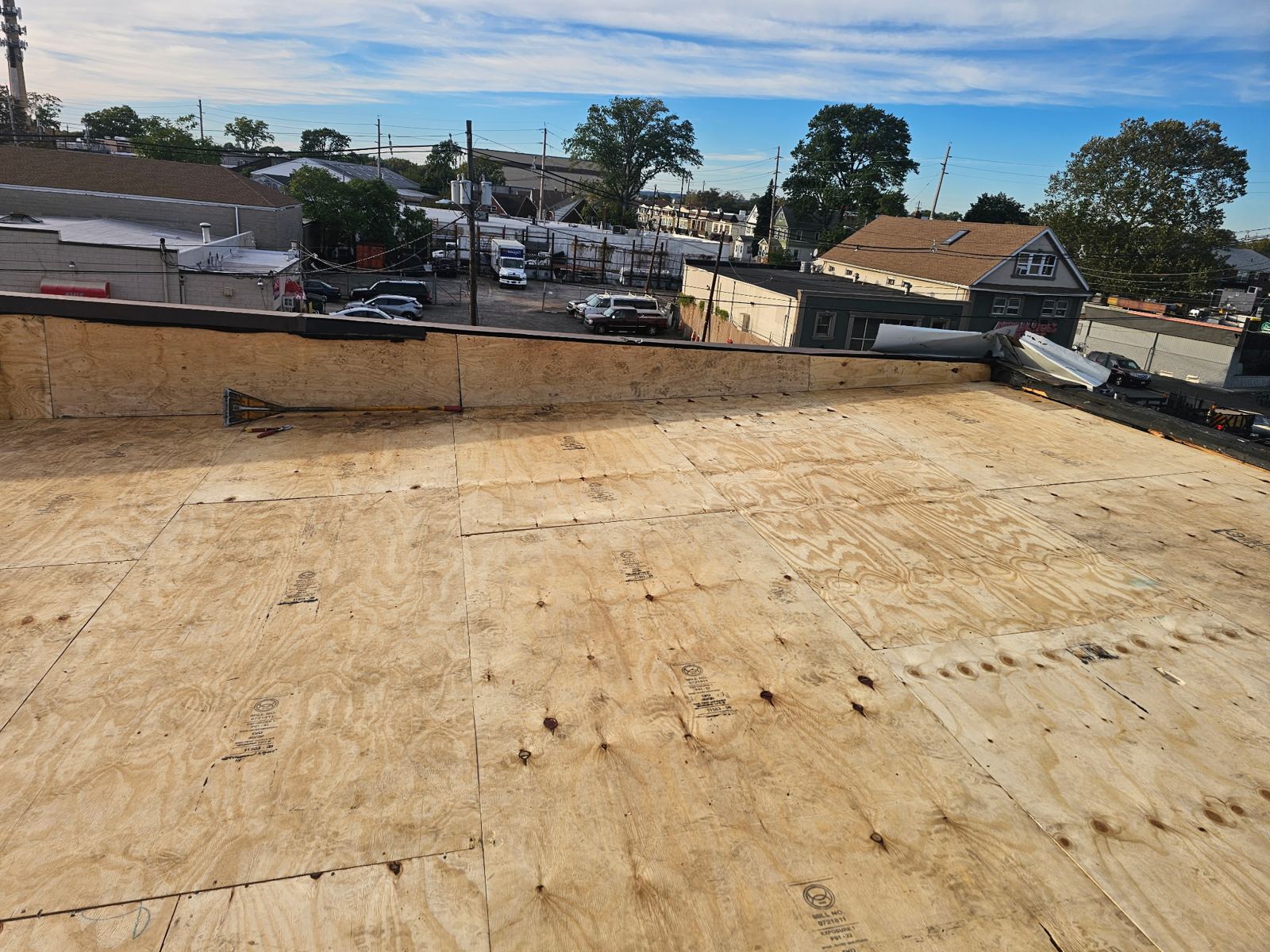
- Decking inspection to ensure structural plywood or tongue-and-groove boards remain sound
Clark questions we get asked
- Does Clark Township require a permit for simple roof repairs?
- Clark Township Construction Code Enforcement generally requires permits for structural work and larger roofing projects. Minor repairs involving a small patch of shingles or isolated flashing touch-ups typically do not require full permits, but larger square-footage repairs or deck replacements do. We verify permit requirements directly with the municipal building department before beginning work.
- Why do post-war Cape Cod homes in Clark develop leaks around dormers?
- Cape Cod homes in Clark feature vertical dormer walls that meet low-sloped roof lines. These intersections rely on step flashing beneath the siding. Over decades, thermal expansion, siding degradation, and aging underlayment cause water to bypass the flashing, resulting in active leaks along second-floor ceilings.
- What should I do first if my roof leaks during a storm in Clark?
- Contain interior water flow using buckets and clear furniture from the affected space. Do not attempt to climb onto a wet roof. Contact Storm Guard Roofing at (201) 403-0024 for 24/7 emergency response. We will dispatch a crew to apply temporary tarping and stop water entry until permanent repairs can be executed.
- Can Storm Guard Roofing assist with wind damage insurance claims in Clark?
- Yes. We document wind and storm damage, prepare technical repair estimates, and meet directly with your insurance adjuster on-site at your Clark property to ensure all damaged roofing components and hidden structural items are included in the claim scope.
More in Clark
Call (201) 403-0024 for a Clark inspection, or send the form.