Dumont · Bergen County
Targeted Roof Repair Services in Dumont, NJ
Dumont residential neighborhoods feature mid-century residential architecture built heavily during the post-war expansion. A substantial portion of the borough housing stock consists of post-war capes with short eaves, sectional gutters, and limited attic ventilation. These structural characteristics create specific moisture and heat trapping vulnerabilities during North Jersey freeze-thaw cycles, driving heavy rain under shingles and backing ice up into the wall cavities along rafter lines. Storm Guard Roofing provides targeted roof repair services in Dumont to resolve structural leaks, flashing breakdowns, and wind damage without forcing an unnecessary full replacement. Family-owned and operating for more than 25 years, we are fully licensed and insured contractors available 24/7 for emergency leaks. We also directly assist homeowners with insurance claims after severe storm events. Call (201) 403-0024 to dispatch a repair technician.
Structural Leak Diagnostics for Dumont Housing Stock
Identifying leaks on Cape Cod structures requires analyzing how water travels down steep upper slopes onto low-pitch dormer transitions. Post-war capes with short eaves, sectional gutters, and limited attic ventilation experience distinct failure modes. Short eaves offer minimal overhang protection, exposing fascia boards, soffits, and upper exterior walls to direct water runoff when sectional gutter seams leak or overflow.
When attic spaces lack adequate intake and exhaust ventilation, interior heat migrates into the roof deck during winter, melting snow cover. That runoff freezes at the cold eave line, creating ice dams that force meltwater backward under asphalt shingles. Leak entry points indoors rarely sit directly beneath the point of roof penetration; water often flows along structural rafters down to ceiling light fixtures or exterior sidewalls before manifesting inside.
- Sidewall step flashing leaks where upper Cape Cod dormers meet main roof slopes.
- Water backup behind clogged or undersized sectional gutter seams along narrow eaves.
- Attic condensation caused by inadequate ridge and soffit airflow mimicking roof leaks.
- Pipe boot seal cracking due to UV degradation and temperature shifts in Bergen County.
Flashing Failure Mechanics and Valley Repair Specifications
Roof valleys and wall intersections accommodate the highest volumes of runoff during high-density precipitation events in Dumont. Flashing failures are responsible for most chronic residential roof leaks. Improperly integrated step flashing along sidewalls or deteriorated lead counter-flashing on brick chimneys allows rainwater to enter behind siding materials and framing.
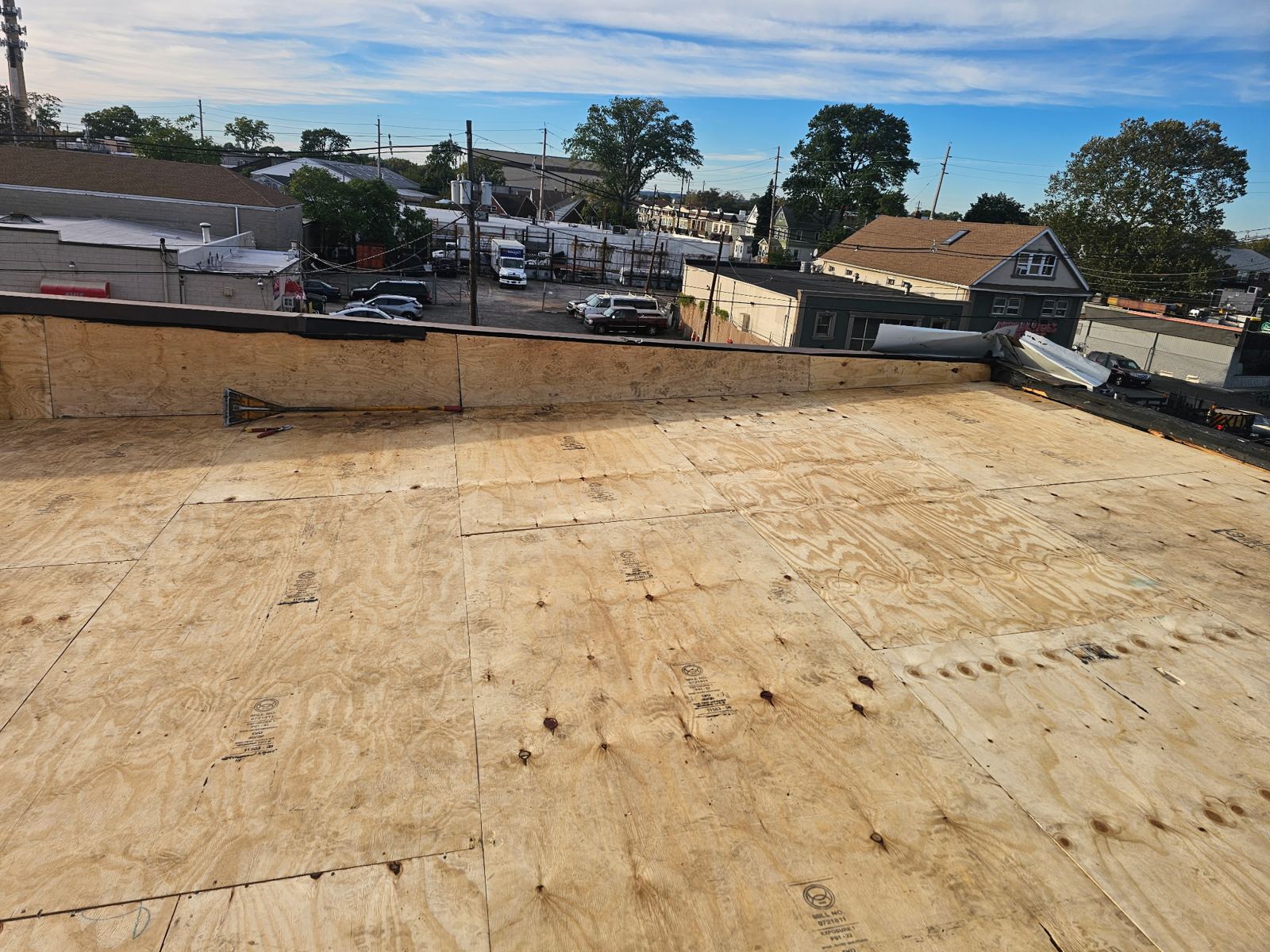
Re-roofing over damaged flashing is a temporary fix that leads to concealed deck decay. Repairing flashing properly requires removing surrounding shingle coursing down to the bare plywood or tongue-and-groove roof deck, inspecting for dry rot, installing high-temperature self-adhering membrane underlayment, and weaving new step flashing into the shingle layers. Valley repairs involve stripping out worn woven or open metal valleys, evaluating the plywood deck substrate, and reinstalling metal valley flashing backed by ice barrier protection.
- Custom lead counter-flashing mortar joint resets for aged brick chimneys.
- Application of self-adhering ice and water membrane across exposed valley substrates.
- Replacement of corroded wall step flashing using heavy-gauge aluminum or copper.
- Installation of integrated kick-out flashing to divert water away from exterior siding.
Emergency Tarping, Wind Damage, and Insurance Claim Processing
Severe coastal storms, wind events, and summer line squalls regularly blow through Bergen County, dislodging architectural and 3-tab asphalt shingles. When wind uplift breaks the adhesive seal on older shingles, water penetrates the underlying roof felt during wind-driven rain. Storm Guard Roofing maintains a 24/7 emergency repair unit to stabilize damaged roofs in Dumont immediately, preventing interior structural damage.
Emergency tarping involves securing heavy-duty wooden furring strips over industrial tarps anchored into solid roof framing—never relying on weighted objects that slide off steep slopes. Following stabilization, we document all structural damage, shingle blow-offs, and compromised decking to assist homeowners through the property insurance claim process. We provide detailed photographic evidence and line-item repair scopes aligned with standard insurance estimating software.
- 24/7 rapid dispatch for emergency structural tarping and storm damage mitigation.
- Mechanical securement of weather barriers designed to withstand elevated wind loads.
- Detailed physical damage reports and line-item estimates for insurance adjusters.
- Comprehensive repair of shingle blow-offs, torn underlayment, and exposed ridge caps.
Cost-Benefit Analysis: Localized Repair vs. Complete Replacement
Roof replacement is not always necessary when leaks occur. If the overall shingle field remains pliable, retains granular coating, and has remaining service life, localized spot repair is the economically sensible choice. Repair costs represent a fraction of complete roof replacement expenses, allowing Dumont homeowners to maximize the return on their original roofing investment.
Determining whether to repair or replace hinges on three core metrics: the physical age of the shingle layer, the percentage of damaged surface area, and the condition of the plywood decking underneath. If damage is isolated to bad flashing, a damaged valley, or localized storm uplift, targeted repairs extend the overall system service life by years. However, if shingle fields are brittle, curling, and losing granules across multiple slopes, spot repairs become inefficient, and full replacement should be evaluated.
- Targeted repair isolates and eliminates water entry points without tearing off functional shingles.
- Significant cost savings by preserving undamaged underlayment and shingle fields.
- Decking evaluation during repair ensures rotten structural sheathing is replaced locally.
- Prevents unnecessary expenditure when structural issues are confined to flashing or valleys.
Dumont Building Code Compliance and Local Environmental Exposures
Roof repairs in the Borough of Dumont must adhere to the New Jersey Uniform Construction Code (NJ UCC). Minor spot repairs generally do not require full municipal building permits, but structural sheet repairs, extensive sub-decking replacement, or alterations to roof framing fall under local building department jurisdiction. Storm Guard Roofing ensures all repair work complies with local codes, including proper installation of ice barrier protection along eave lines where required.
Microclimates in Bergen County subject homes near major corridors like Knickerbocker Road, Madison Avenue, and Washington Avenue to significant seasonal stress. High winds, heavy wet snow, and prolonged freeze-thaw cycles test localized sealants and flashing joints. Proper repair techniques utilize cold-weather synthetic underlayments, corrosion-resistant fasteners, and heavy-duty sealants rated for northern New Jersey climate swings.
- Full compliance with New Jersey Uniform Construction Code and Dumont building standards.
- Ice barrier membrane installation meeting municipal requirements along critical eaves.
- Fastener selection designed for severe Bergen County freeze-thaw expansion cycles.
- Sub-decking replacement using exterior-grade CDX plywood matching existing deck thickness.
Dumont questions we get asked
- How do Dumont's post-war Cape Cod roofs complicate leak detection and repair?
- Cape Cod homes in Dumont often feature short eaves, sectional gutters, and limited attic ventilation. Heat escaping into tight attic cavities causes uneven snow melting and ice damming at the eaves. Water forced under shingles travels along steep roof rafters, often dripping far from the actual entry point, requiring systematic attic and exterior diagnostic inspection.
- Does a minor roof repair in Dumont require a municipal building permit?
- Minor shingle replacement and localized flashing repairs typically do not require a permit from the Dumont Building Department under the NJ Uniform Construction Code. However, larger structural repairs involving significant sheathing replacement or altering structural roof framing require formal permits and inspections.
- How does Storm Guard Roofing handle emergency storm damage repairs and insurance claims in Dumont?
- We operate a 24/7 response service to perform emergency tarping using furring strips anchored into solid structural framing. Once the home is stabilized, we generate photographic documentation and line-item estimates required by insurance adjusters, helping guide Dumont homeowners through the property claim workflow.
- When is a localized roof repair sufficient instead of a total roof replacement?
- Localized repair is sufficient when the surrounding shingles remain flexible, retain their protective granule layer, and the underlying deck is structurally sound. If water intrusion is traced to localized flashing failures, pipe boots, valley wear, or isolated wind uplift, spot repairs resolve the leak without the cost of a full tear-off.
More in Dumont
Call (201) 403-0024 for a Dumont inspection, or send the form.