Saddle Brook · Bergen County
Targeted Roof Repair Services in Saddle Brook, NJ
Storm Guard Roofing provides direct, focused roof repair services for residential properties throughout Saddle Brook, New Jersey. With over 25 years of continuous operation, our family-owned, licensed, and insured company specializes in resolving localized roof leaks, flashing breakdowns, structural decking rot, and severe storm damage. We maintain a 24/7 emergency response capability and manage insurance claims directly on behalf of homeowners facing sudden storm events. Saddle Brook features specific post-WWII housing stock that presents recurring, localized roof vulnerabilities. Rather than pushing total roof replacements when existing shingle fields remain sound, we perform targeted technical repairs that restore weather protection and extend the working lifespan of your present roof. Call (201) 403-0024 for an immediate on-site assessment.
Leak Vulnerabilities in 1950s Saddle Brook Capes and Ranches
Saddle Brook's suburban development expanded rapidly in the 1950s, creating neighborhoods populated largely by Cape Cod and ranch-style homes, such as those along Midland Avenue, Cambridge Avenue, and Saddle River Road. These structures were built with specific architectural features that dictate how roof leaks develop: short 4-to-6-inch soffit overhangs and original 2x3-inch downspouts that are undersized for contemporary high-volume rainfall events in Bergen County.
When torrential rains strike Saddle Brook, undersized 2x3 downspouts frequently back up, filling gutters past capacity. Because the roof overhangs extend only inches from the sidewalls, gutter overflow runs down fascia boards and migrates upward beneath lower shingle courses via capillary action. Simultaneously, short rake overhangs leave gable-end rake boards, step flashing, and sidewall joints completely exposed to wind-driven rain. Over time, water penetrates these exterior transitions, rotting rafter tails and ceiling drywall.
- Water backup beneath starter shingle courses caused by overflowing, undersized 2x3-inch downspouts.
- Accelerated rake-edge soffit and fascia rot due to short 4-to-6-inch roof overhangs on 1950s homes.
- Deterioration of neoprene rubber boots surrounding 1.5-inch to 3-inch plumbing vent stacks, leaking into interior walls.
- Fastener back-out and nail-pop leaks caused by continuous thermal expansion and contraction cycles.
Flashing Failures, Dormer Transitions, and Valley Repair
Cape Cod homes in Saddle Brook commonly feature second-floor dormers. The wall-to-roof intersection on these dormers relies on step flashing woven into each individual shingle course. Over decades of New Jersey temperature fluctuations, metal flashing expands, contracts, and pulls away from wall sheathings. Subcontractors installing retrofitted vinyl siding frequently fail to interleave new step flashing properly, allowing water to stream behind wall cladding into structural framing.
Roof valleys present another critical failure point. Older open metal valleys rust through, while closed-cut or woven asphalt shingle valleys collect debris and trap moisture along pitch changes. Heavy rain scours protective granules off valley shingle channels, exposing the underlying asphalt core to ultraviolet breakdown, cracking, and eventual water penetration. Chimney counter-flashing also deteriorates where lead or aluminum inserts enter brick mortar joints, leading to ceiling staining around living room fireplace flues.
- Precision replacement of corroded, buckled, or missing step flashing along dormer sidewalls.
- Tear-out of deteriorated closed-cut valleys and installation of self-adhered membrane with heavy-gauge metal valley lining.
- Mortar joint repointing and counter-flashing re-securing along original mid-century brick chimneys.
- Repair of wall-to-roof apron flashing transitions on rear family room additions.
Emergency Tarping and Storm Damage Response
High wind events, severe summer thunderstorms, and winter nor'easters in Bergen County regularly detach aged shingle tabs, strip ridge caps, or drop heavy tree limbs onto roof decks. Storm Guard Roofing delivers 24/7 emergency response to stabilize compromised roofs immediately, stopping interior damage before permanent structural repairs begin.
Our emergency crews use mechanical securing methods for temporary coverings rather than driving nails directly through good shingles. Tarps are stretched drum-tight and fastened using dimensional 2x4 wooden furring strips anchored securely to structural rafters or sound roof decking. This wind-resistant installation technique withstands subsequent storm fronts without creating additional leak paths. For storm damage covered by property insurance, we generate itemized damage scopes, capture detailed photo documentation, and meet directly with insurance adjusters.
- 24/7 emergency dispatch for tree impact punctures, severe wind lift, and structural envelope breaches.
- Lumber-anchored emergency tarping engineered to resist high wind pressure without shingle field damage.
- Detailed insurance claim management including itemized line-item estimates and technical reporting.
- Replacement of blown-off ridge cap shingles and matching missing architectural or 3-tab shingle sections.
Roof Repair vs. Replacement: Technical and Financial Factors
Full roof replacements require substantial capital outlay. On many Saddle Brook properties, water intrusion is restricted to isolated component failures rather than widespread shingle failure. A targeted roof repair is structurally sound and financially practical when surrounding shingles maintain granule coverage, remain pliable, and adhere tightly to adjacent courses.
If a roof is under 15 to 18 years old and the underlying roof decking exhibits no structural rot, replacing isolated flashing runs, pipe boots, or shingle sections stops leaks while preserving your remaining roof lifespan. Complete replacement is warranted only when shingles show broad granule loss across all exposures, wood decking shows widespread decay, or multiple existing layers prevent code-compliant flashing installation.
- Targeted repairs eliminate active leaks while preserving functioning, viable shingle acreage.
- Inspection of 1x6 tongue-and-groove or CDX plywood roof decking prior to installing repair materials.
- Cost-effective resolution of isolated storm, flashing, or penetration damage.
- Factual assessment of shingle tensile strength and deck stiffness to establish repair viability.
Saddle Brook Permit Regulations and Roof Deck Inspections
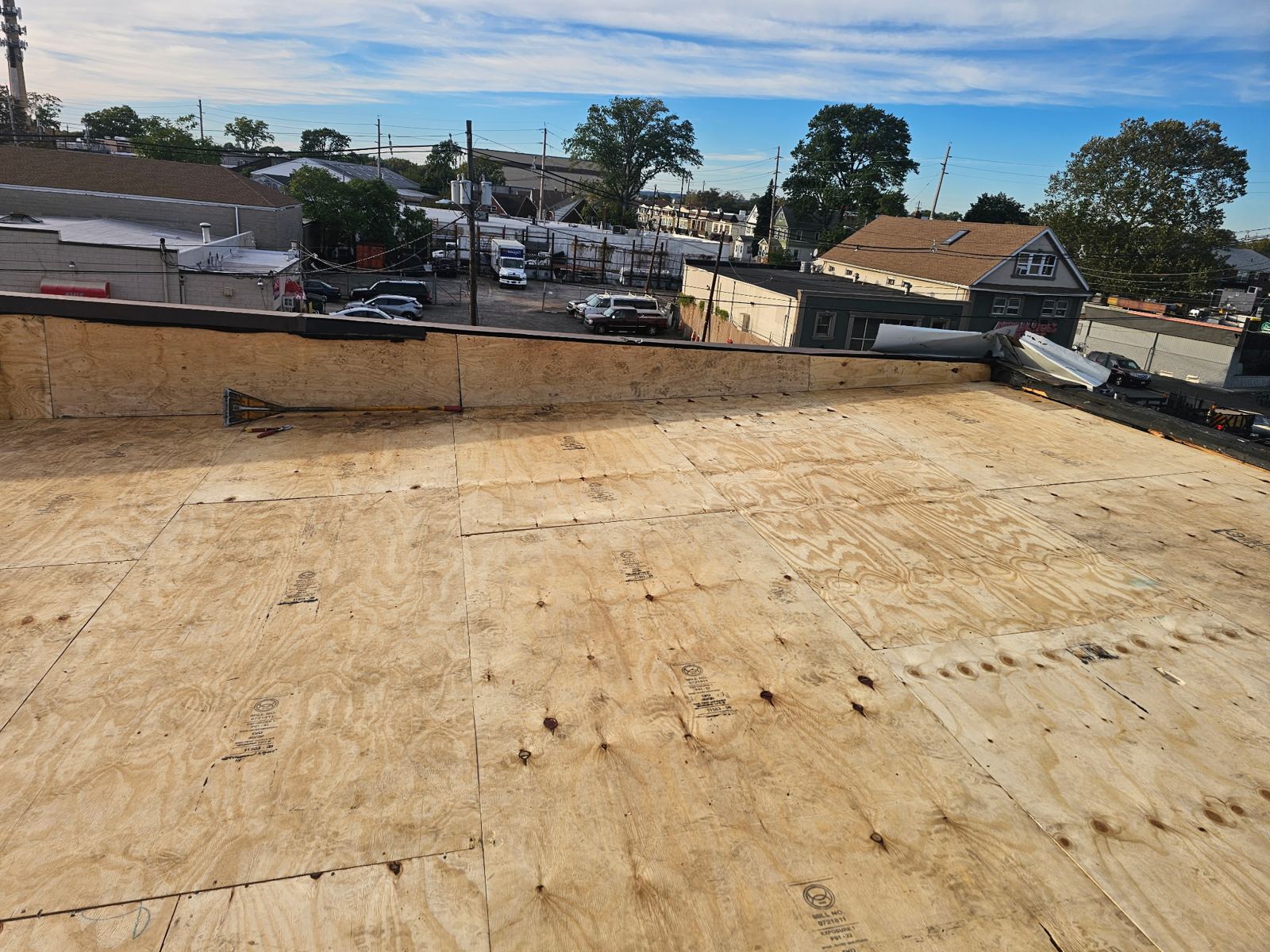
Roof repairs involving structural framing or decking replacement in Saddle Brook must comply with New Jersey Uniform Construction Code standards enforced by the Saddle Brook Township Construction Office. When repairing localized roof leaks, the underlying wood sheath boards must be exposed and inspected for rot, delamination, or mold.
1950s homes in Saddle Brook frequently feature 1x6 tongue-and-groove or 1x8 pine shiplap roof sheathing rather than modern CDX plywood sheets. When chronic leaks rot these solid boards, replacing damaged sections with matching-thickness lumber ensures a continuous, rigid, flush deck substrate. We install self-adhering ice and water membrane over repaired decking prior to nailing new shingles, guaranteeing compliance with local structural codes.
- Removal and replacement of rotted 1x6 tongue-and-groove wood decking or delaminated plywood sheathing.
- Installation of code-mandated self-adhered ice and water shield along eaves, valleys, and critical repair zones.
- Adherence to Saddle Brook Township building permit requirements for structural roof repairs.
- Post-repair water testing to verify watertight performance across all replaced flashing and shingle courses.
Saddle Brook questions we get asked
- How do short overhangs on 1950s Saddle Brook homes affect roof leak repairs?
- Short 4-to-6-inch soffit overhangs provide minimal protection for gable-end rake boards and fascia. Wind-driven rain easily blows under shingle edges, while overflowing 2x3 downspouts force water directly under starter shingle courses. Repairing these roofs requires stripping edge shingles, inspecting the fascia and rafter ends for wood rot, and installing self-adhering ice and water membrane along the entire eave and rake line before installing new drip edge metal.
- Do I need a Saddle Brook Township building permit for a localized roof leak repair?
- Minor shingle patch repairs, single-pipe boot replacements, and localized flashing fixes typically do not require a building permit from the Saddle Brook Township Construction Office. However, if the repair requires replacing structural roof decking or spans significant portions of the roof slope, a permit may be required. Storm Guard Roofing reviews local municipal code guidelines for your specific project and handles all permit filings when necessary.
- How does Storm Guard Roofing secure emergency tarps during severe weather?
- We avoid driving nails into undamaged shingles or using weight sandbags that slip off slopes. Our technicians stretch heavy-duty, UV-resistant tarps across the damaged roof section and secure them using dimensional 2x4 lumber strips screwed directly into structural rafters or solid roof decking. This creates a secure seal capable of withstanding high-wind conditions in Bergen County.
- How do I know if my roof leak requires a simple repair or a full replacement?
- If your roof is under 15 to 18 years old, the shingle field retains structural integrity and granules, and the leak originates from a specific point—such as a cracked pipe boot, damaged step flashing, or localized wind uplift—a repair is the correct choice. If shingles are curling, losing granules across all exposures, or the deck sheathing exhibits widespread rot, we provide a factual evaluation detailing why full replacement is recommended.
More in Saddle Brook
Call (201) 403-0024 for a Saddle Brook inspection, or send the form.