Old Bridge · Middlesex County
Roof Repair Services in Old Bridge, New Jersey
Storm Guard Roofing provides targeted roof repair services across Old Bridge, Middlesex County, New Jersey. With over 25 years of experience as a family-owned, licensed, and insured contractor, we focus on identifying the exact root cause of roof leaks and performing targeted structural repairs. Whether your roof has sustained wind damage from a coastal nor'easter, developed a valley failure, or suffered seal failure around a plumbing stack, our technicians deliver immediate diagnostics and long-term repair solutions. We provide 24/7 emergency response for active leaks, perform temporary emergency tarping, and directly handle the technical documentation required for insurance claims. For immediate service or to schedule an on-site inspection in Old Bridge, contact Storm Guard Roofing at (201) 403-0024.
Old Bridge Housing Stock and Roofing Vulnerabilities
Old Bridge Township features extensive housing developments built primarily between the 1970s and 1990s, including subdivisions in neighborhoods such as Madison Park, Sayrewoods, Browntown, and Cheesequake. A significant portion of these homes was originally constructed with standard three-tab asphalt shingles. These original installations have far exceeded their design service life of 20 to 25 years. Exposed to Middlesex County climate extremes—ranging from high summer humidity and UV exposure to sub-freezing winter temperatures and wind-driven rain from Raritan Bay—these aging shingles lose their volatile oils, become brittle, and shed protective ceramic granules.
As asphalt shingles age past their service limits, adhesive seal strips fail, leaving individual shingle tabs susceptible to blow-offs during routine wind events. In 1970s-90s split-levels, ranches, and two-story colonials across Old Bridge, roof failures frequently manifest along lower eaves, roof transitions, and around architectural dormers where water runoff accumulates in high volume.
- Brittle 215 lb three-tab shingles past their 20-25 year service life showing thermal cracking and loss of flexibility.
- Widespread granule loss exposing underlying fiberglass or organic matting to accelerated UV degradation.
- Worn adhesive seals leading to uplift during moderate wind storms along exposed ridgelines and gables.
- Ice dam formation along uninsulated overhangs and deep eaves during Central Jersey winter freeze-thaw cycles.
Technical Leak Diagnostics and Primary Source Failure Points
Water entering a dwelling rarely drips straight down from the point of exterior shingle failure. Water routinely migrates along rafter boards, subflooring, and underlayment laps before penetrating interior ceiling drywall or plaster. Storm Guard Roofing utilizes systematic physical inspection techniques to trace active leaks back to their precise point of entry, avoiding unneeded work on non-leaking sections.
Structural penetrations represent the highest statistical probability for roof failure. Neoprene pipe boots on plumbing vent stacks degrade under UV exposure within 10 to 12 years, splitting along the collar and allowing water to travel directly down the vent pipe into interior walls. Similarly, step flashing along sidewalls and counter-flashing embedded into brick chimney mortar joints deteriorate due to differential expansion and contraction between dissimilar building materials.
- Cracked or split rubber neoprene boots on plumbing stacks allowing water entry along the vent pipe chassis.
- Step flashing separation at dormer sidewalls caused by thermal expansion and settling of framing members.
- Counter-flashing mortar joint failure on brick and masonry chimneys leading to rear-saddle leaks.
- Granule erosion and seal failure in high-velocity drainage valleys where roof planes meet.
Flashing, Valley, and Structural Component Failures
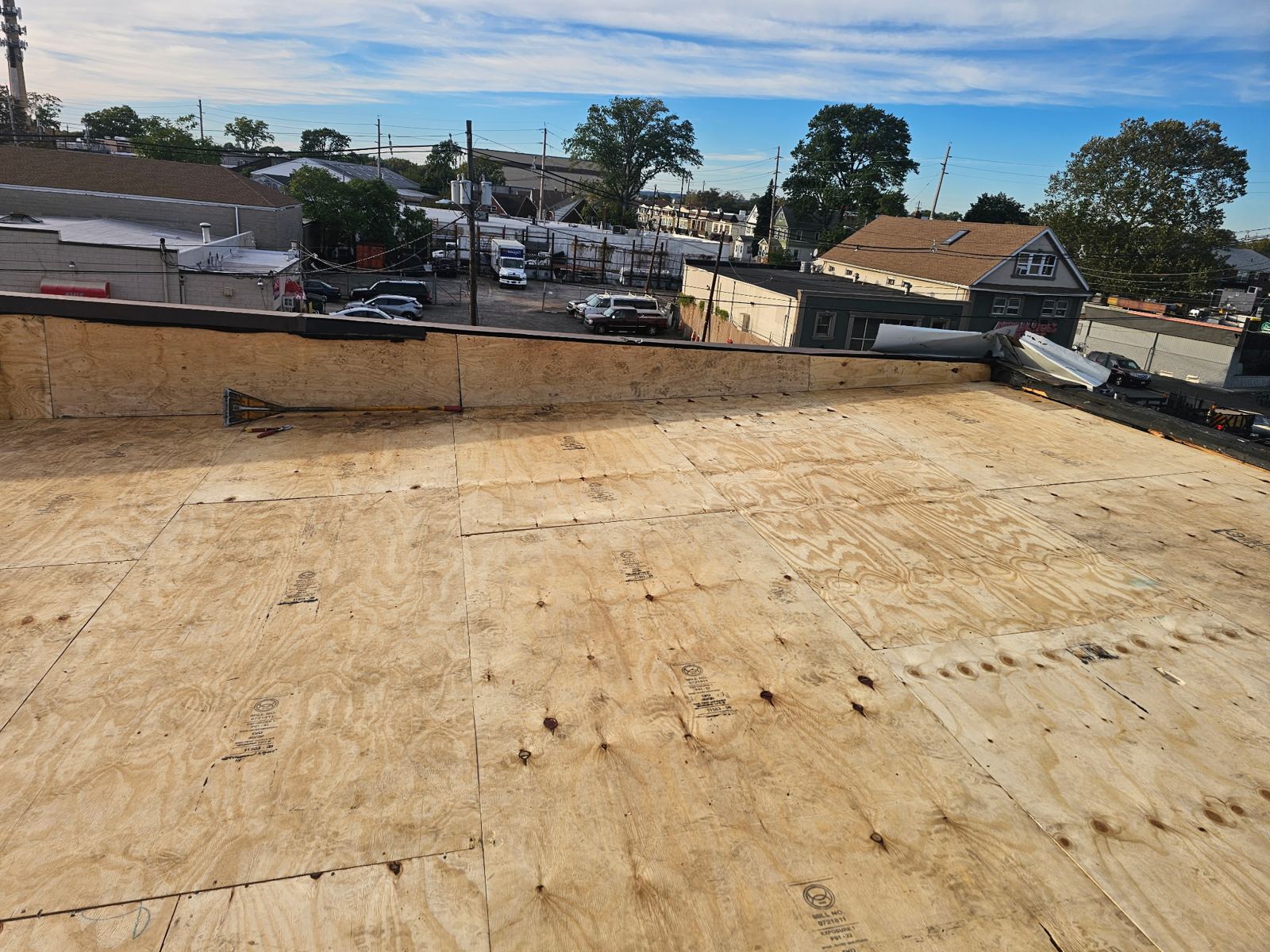
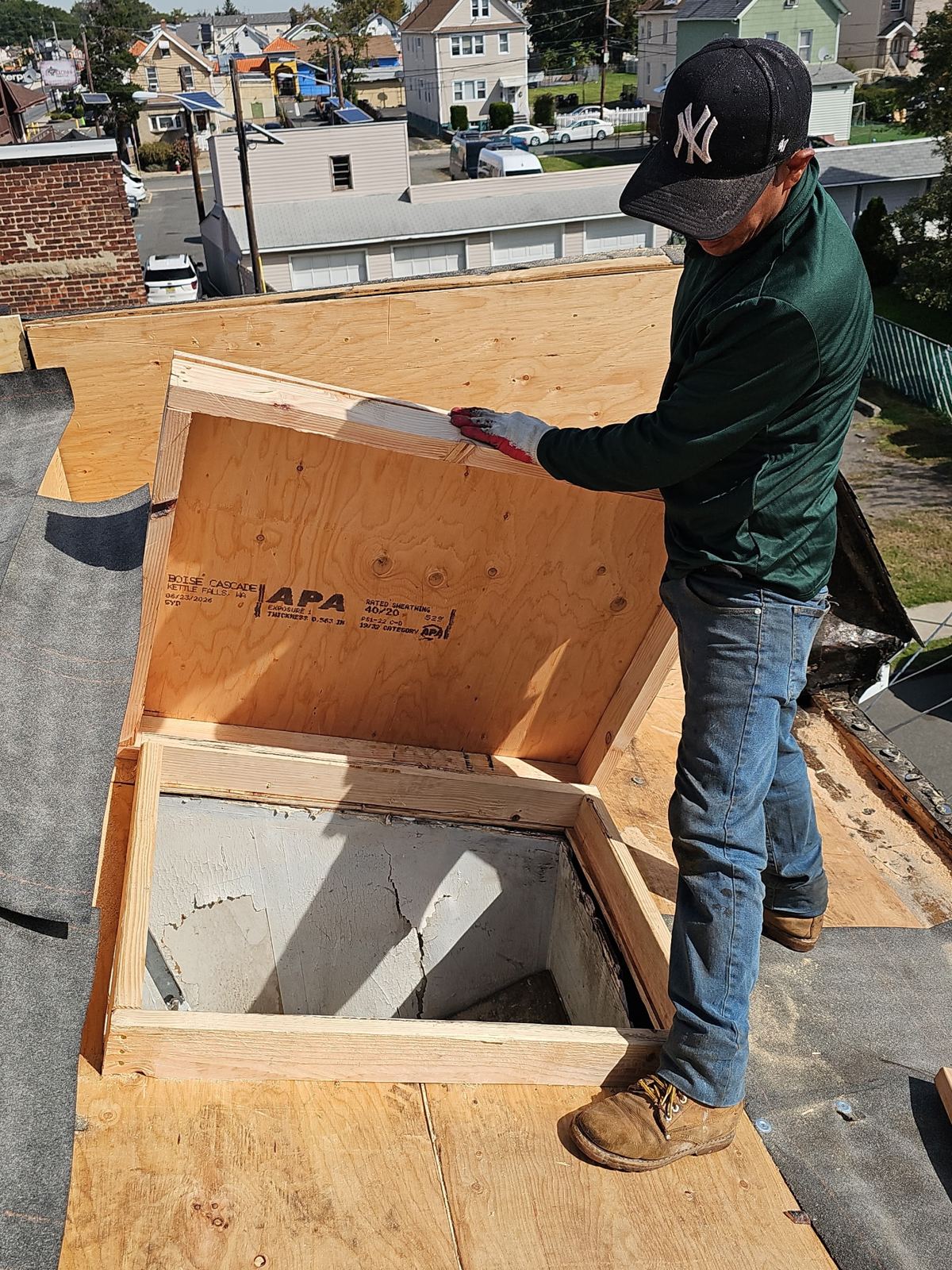
Repairing a roof leak requires correct material integration rather than temporary surface sealants or caulking, which quickly break down under temperature fluctuations. When repairing a valley or wall junction, surrounding shingles must be unsealed and removed to expose the underlying decking. Damaged or rotted CDX plywood or oriented strand board sheathing is cut out back to the center of adjacent rafters and replaced with fresh, code-compliant wood panels.
To establish a watertight barrier, self-adhering polymer-modified asphalt ice and water shield membranes are applied directly to the bare deck before new flashing is installed. We install heavy-gauge aluminum or copper step flashing woven into each shingle course, ensuring gravity directs water onto the upper surface of the lower shingle rather than beneath the assembly. Valleys are restored using either closed-cut methods or open metal flashing channels designed to clear heavy water flow and debris buildup efficiently.
- Replacement of delaminated or water-damaged CDX plywood sheathing to restore structural nail-holding integrity.
- Installation of polymer-modified ice and water membranes in all repaired valley zones.
- Integration of corrosion-resistant aluminum or copper step flashing tucked behind existing wall siding.
- Hand-nailing replacement shingles using hot-dipped galvanized roofing nails driven to correct penetration depth.
Emergency Tarping and Storm Damage Repairs
High-wind events, hail, and fallen tree limbs from severe storms can compromise a roof instantly, creating active water entry into living areas. Storm Guard Roofing maintains a 24/7 emergency response capability for Old Bridge property owners. Our immediate priority during an emergency call is structural stabilization through heavy-duty emergency tarping, preventing secondary interior damage to drywall, electrical systems, and structural framing.
Following emergency containment, we conduct a comprehensive field assessment to document all storm-induced damage. Storm Guard Roofing handles the technical logistics of insurance claims directly with your carrier. We compile photo documentation, line-item scope reports specifying exact damage locations, and material requirements to ensure your claim reflects the full extent of necessary repairs according to local building standards.
- Rapid-dispatch 24/7 emergency tarping and roof stabilization to prevent active interior water intrusion.
- Comprehensive physical damage assessments, including attic space inspection for structural rafter damage.
- Detailed line-item scope preparation for submission to insurance field adjusters.
- Representation during adjuster field visits to verify all storm-caused structural deficiencies are documented.
Evaluating Repair versus Replacement Economics
Homeowners in Old Bridge often face the choice between spot repairs and complete roof replacement. Performing a targeted repair is mathematically and structurally sound when the compromised area is localized—such as isolated wind damage, a failed flashing detail, or puncture damage from debris—provided the surrounding shingle matrix retains sufficient adhesion, granule cover, and tensile flexibility.
A targeted repair on an aging roof can extend total service life by 5 to 10 years at a fraction of full replacement overhead. However, if a roof exhibits widespread loss of adhesion across multiple slopes, brittle shingles that snap when lifted for flashing insertion, or structural decking rot covering more than 25 to 30 percent of the total square footage, repeating spot repairs becomes economically inefficient. We provide factual, objective assessments so homeowners can evaluate the direct trade-offs between repair investments and long-term asset protection.
- Targeted repair focus: Isolates and resolves localized failure points without disturbing sound roofing assemblies.
- Preservation of functional roof life: Extends system viability when the remaining shingle field is structurally intact.
- Clear diagnostic reporting: Evaluates shingle flexibility, decking integrity, and overall surface wear prior to recommending work.
- Cost efficiency: Avoids the capital expense of complete tear-off when structural integrity can be fully restored via spot repair.
Old Bridge questions we get asked
- Do I need a construction permit from Old Bridge Township for a minor roof repair?
- Old Bridge Township typically requires building permits for full roof replacements or structural timber repairs, but minor spot repairs, pipe boot replacements, and localized flashing fixes generally do not require permits. Storm Guard Roofing verifies compliance with the Old Bridge Township Construction Department prior to executing major repairs.
- Why are three-tab roofs in 1970s and 1980s Old Bridge subdivisions failing around the valleys?
- Subdivisions built in neighborhoods like Madison Park or Browntown during the 1970s and 1980s frequently utilized standard three-tab shingles over basic organic felt. Over 25 to 30 years, thermal expansion, UV degradation, and seasonal freeze-thaw cycles cause the asphalt matting to dry out and split, particularly along high-volume drainage valleys.
- How quickly can Storm Guard Roofing secure my roof in Old Bridge after severe storm damage?
- Storm Guard Roofing operates a 24/7 emergency response service for Old Bridge homeowners. We dispatch technicians to perform emergency tarping and temporary containment to stop active water intrusion, followed by a formal structural assessment for your insurance claim.
- How do I know if my roof requires a localized repair instead of a full replacement?
- If damage is confined to a specific zone—such as deteriorated pipe boots, isolated wind-scoured shingles, or damaged flashing around a chimney—and the surrounding shingles retain flexibility and granule adhesion, a targeted repair is structurally appropriate. If over 25 to 30 percent of the roof surface exhibits severe decay, replacement may be recommended.
More in Old Bridge
Call (201) 403-0024 for a Old Bridge inspection, or send the form.